The Supreme Court struck down Trump’s tariffs Friday. By Saturday he’d raised them to 15% under a different law. This is about the version of the problem that debate can’t reach.
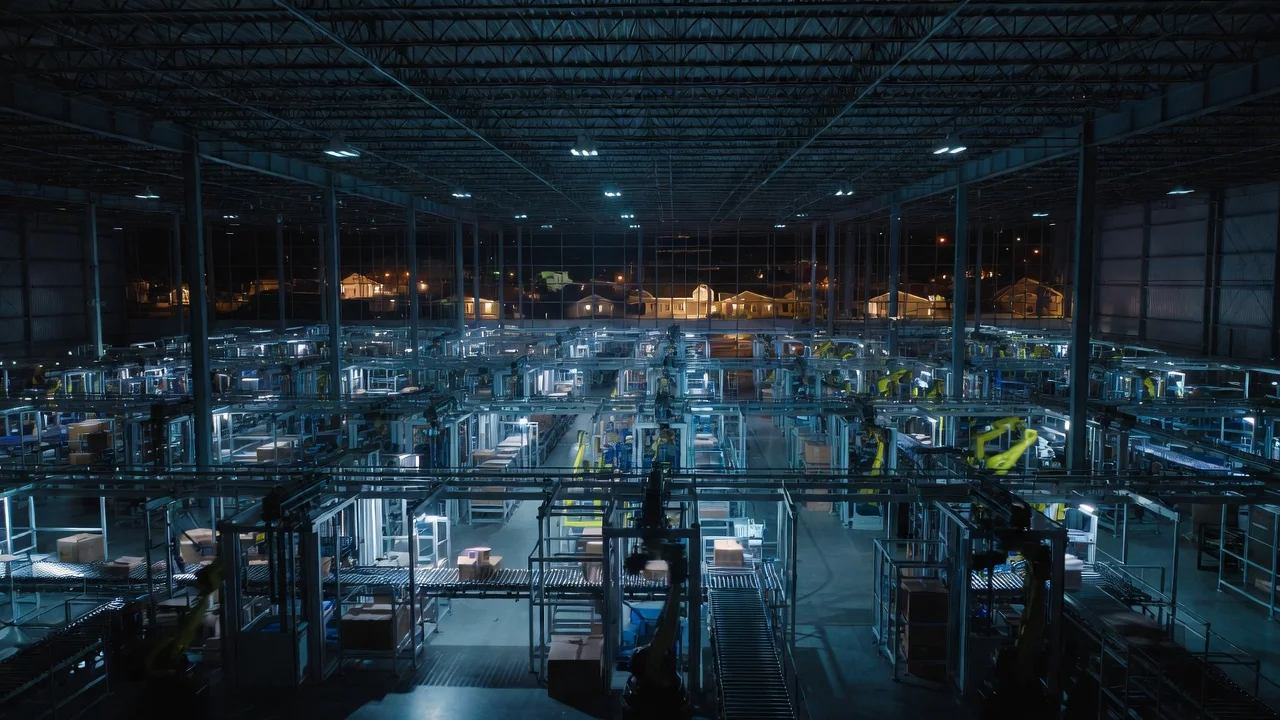
A company can stop contributing to the society it profits from without moving a single job overseas. A robotized warehouse doesn’t cross a border. Software replacing a call center doesn’t cross a border. An AI agent handling work that employed fifty people doesn’t cross a border. The company stays entirely domestic and still hollows out its obligation to the society it sells into.
This is the version of the offshoring problem that tariffs don’t touch — and it’s the one that’s actually accelerating.
The underlying concern behind tariffs is legitimate: companies should contribute something to the societies they profit from. A company can design products in one country, manufacture in another, sell to consumers in a third, and route profits through a fourth — and its obligation to any of those societies can be structured to approach zero. Tariffs are a clumsy attempt to capture value at the point of transaction. But they only address goods crossing a border. The structural shift is happening inside borders, in every industry, simultaneously.
There’s an additional irony: tariffs don’t just miss the domestic automation problem — they accelerate it. When tariffs raise the cost of imported goods, manufacturers look for cost offsets. The cheapest one is domestic automation: capital expenditure, fully deductible upfront under current tax law. The Kansas City Fed found that sectors with higher import exposure hired more slowly in 2025, suggesting tariffs may have cost the economy roughly 19,000 jobs per month. The Yale Budget Lab projects the remaining tariffs will raise unemployment by 0.3 percentage points by end of 2026. So tariffs may not bring jobs back — they make robots more competitive than the foreign labor they price out.
Employment Was the Mechanism — Automation Removes It
The mechanism by which companies historically made that contribution wasn’t designed — it evolved. When a company hired workers, those workers paid income taxes, contributed to Social Security, spent locally, and collectively funded the public infrastructure the company’s operations depended on.
Automation removes that mechanism. The tax code actively encourages it: labor costs are recurring and taxable; automation is capital expenditure, deductible upfront. The legal structure, the tax code, and the technology all point the same direction. No current policy points the other way.
The Tax Base Problem This Creates Is Structural
Whether this wave ultimately differs from prior ones is a genuine empirical question — but either way, the structural incentive exists and the CBO has flagged the fiscal risk. In December 2024, the CBO published a landmark analysis of AI’s fiscal impact (CBO, Dec 2024 ), identifying automation-driven displacement as a key fiscal risk: permanently displaced workers reduce income and payroll tax receipts while increasing safety-net claims. If displacement accelerates, the government faces trying to fund an expanding safety net with a shrinking revenue base.
Any income floor — UBI or otherwise — has to come from somewhere. The logical somewhere is corporate taxation. But defining what corporations “owe” when supply chains span twenty countries and customers are global is genuinely hard.
The Robot Tax Doesn’t Work — But There’s a Better Measurement
Most policy proposals reach for a robot tax: charge companies for each position replaced by automation. The impulse is right; the mechanism breaks immediately. Defining what counts as a “robot” is impossible. Does Excel qualify? A CRM that eliminated five data-entry roles? A language model handling work that employed a team?
South Korea’s 2017 experiment is the only real-world test: the government reduced automation investment credits and industries cut robot installations by roughly 28 percent relative to peers . Employment effects were statistically insignificant. The cost to productivity was real; the benefit to workers wasn’t.
A more honest framework doesn’t try to measure automation. It measures the gap between what a company earns in a domestic market and what it contributes via payroll. Domestic payroll as a percentage of revenue — adjusted for sector norms (a semiconductor fab employs far fewer people per dollar of revenue than a grocery chain, and that’s expected) — already exists as reported data. It doesn’t require a new definition of “robot.”
Companies that earn significant domestic revenue while employing proportionally few domestic workers are consuming more public infrastructure per dollar of obligation than their payroll reflects. That gap is what current tax law doesn’t price.
The Window to Fix This Is the Same Window as the Transition
We’ve seen this pattern before. Nobody acted seriously on social media governance until platforms had already accumulated the scale to shape elections. The frameworks were improvised after the power was concentrated — and we’re still arguing about whether any of it worked.
The transition period — when automation is accelerating but hasn’t yet displaced the majority of labor — is when it’s still possible to design funding structures in advance. Once the disruption completes, the question becomes: who already controls the robots? The governance structures that shape that answer either get built during the transition or get imposed after the fact by whoever got there first.
The tariff debate is consuming the political attention that window requires. Tariffs are real-time responses to a real-time trade dispute. The underlying question — how do societies fund themselves when human labor stops being the primary input to production? — is longer-range, harder, and not getting answered.
For the full argument, including the historical counterargument and why this wave may be different: The Full Argument
A note on how this was made: The core argument and thesis are mine. The post was written collaboratively with Claude (Anthropic’s AI), which helped shape the prose and structure.