When the Stack Stops
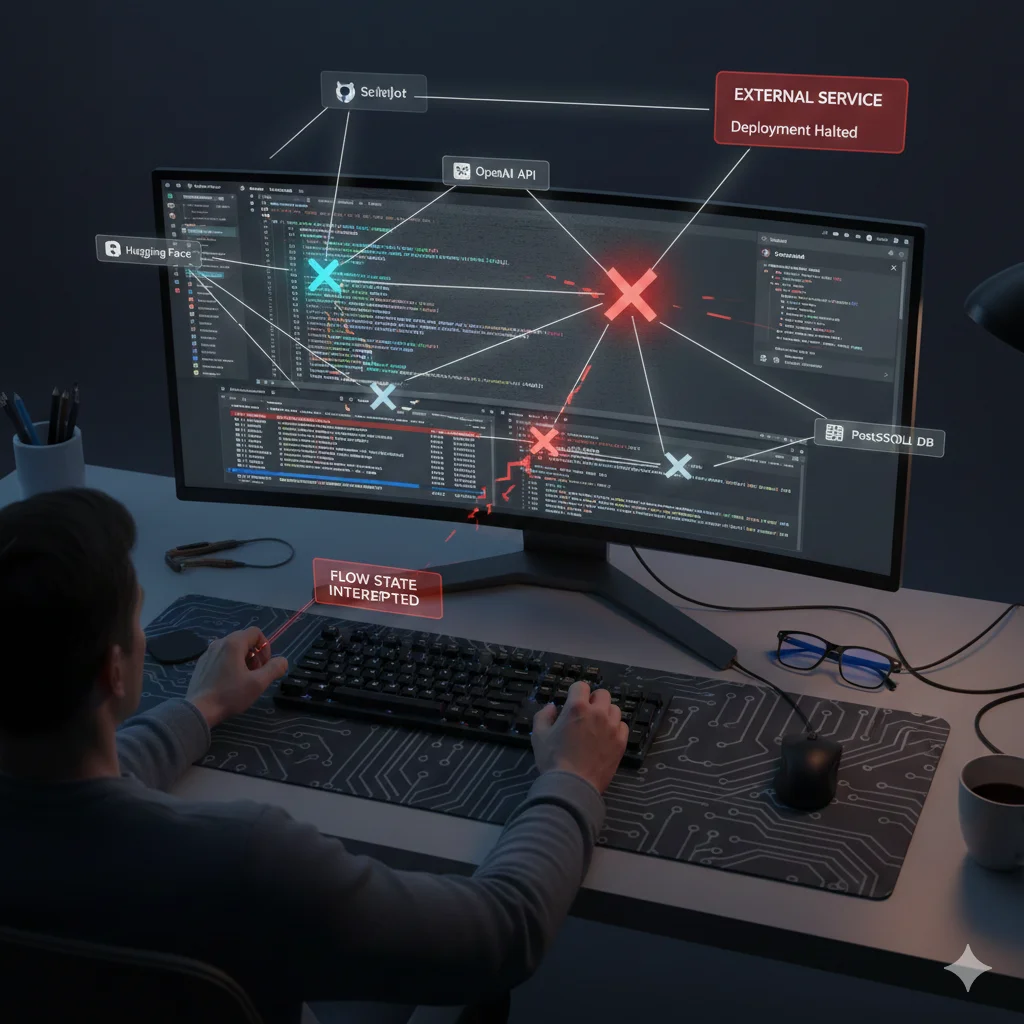
It’s 2:00 PM on February 9th, 2026. I’m in flow—code is shipping, tests are green, the AI assistant is humming along. Then: nothing. I can’t push or pull code—the entire AI-augmented development workflow is frozen.
By 2:30 PM, service is restored. Thirty minutes of downtime.
But here’s the thing: this isn’t really about GitHub. It’s about how AI-augmented development changes the calculus of vendor reliability. When your workflow depends on AI assistance maintaining context across your entire codebase, vendor downtime isn’t just inconvenient—it disrupts the exponential productivity gains that make AI development transformative.
The Compound Dependency Problem
Modern application development runs on a stack of managed services:
- Source control: GitHub, GitLab
- CI/CD: GitHub Actions, CircleCI, Jenkins
- Deployment: Vercel, Netlify, AWS
- AI services: OpenRouter, Anthropic API, OpenAI API, Azure OpenAI
- Databases: Supabase, PlanetScale, MongoDB Atlas
- Monitoring: Datadog, Sentry, New Relic
Each vendor has excellent uptime—typically 99.9% or better. But when you’re composing a dozen services, the compound availability matters:
| |
In traditional development workflows, that math was acceptable. You worked around outages, queued up tasks, context-switched to other projects.
In AI-augmented development, the calculus has changed.
The Reliability Tax: Why AI Amplifies the Cost of Downtime
1. Flow State is Non-Linear in AI-Augmented Workflows
When you’re pair-programming with an AI assistant that maintains context across your entire codebase, an unexpected 30-minute service interruption doesn’t just lose 30 minutes. It loses:
- The multi-file refactoring in progress
- The architectural conversation thread
- The momentum of rapid iteration
- The cognitive state that took 20+ minutes to build
Research on developer flow state suggests it takes 15-30 minutes to reach peak productivity after an interruption. When your workflow is AI-augmented, each interruption has a magnified opportunity cost.
2. Automated Pipelines Are Brittle to Dependency Failures
AI-assisted development often means:
- More frequent deployments (why wait? the AI wrote the tests)
- Tighter feedback loops (instant validation cycles)
- Higher commit velocity (AI handles boilerplate, linting, formatting)
When your deployment pipeline expects GitHub Actions → Vercel → Datadog, and GitHub webhooks fail, the entire automation chain stalls. Manual intervention becomes routine:
- Re-registering runners
- Manually triggering workflows
- Debugging: “Is it my config? The cluster? No—the event was never received.”
When automation assumes perfect reliability , these cascading failures expose the brittleness of overly-orchestrated pipelines. Each manual step is friction in what should be an increasingly frictionless process.
3. The Opportunity Cost Has Shifted
Traditional development: “Downtime is annoying, but I’ll work on something else.”
AI-assisted development: “Downtime blocks the exponential productivity gain I’ve come to rely on.”
The delta matters. The productivity multiplier from AI assistance means vendor downtime has amplified opportunity costs beyond simple clock time.
The Migration Feasibility Shift
Here’s where AI changes the strategic calculation: vendor lock-in is no longer as sticky as it used to be.
When I evaluated alternatives to GitHub (triggered by their short-lived self-hosted runner pricing announcement ), the migration complexity felt prohibitive. The UX gap between GitHub’s polished interface and alternatives like Forgejo seemed insurmountable.
But something fundamental has shifted:
Migration is no longer heroic effort.
The Ghost-to-Hugo migration for this very blog? AI-assisted scripts handled HTML-to-Markdown conversion, frontmatter generation, and internal link fixing. Completed in a single day—work that would have taken weeks of manual effort. Human validated and selected the approach , AI executed the conversion, human validated the output —automation with oversight at both ends.
The same capability applies to:
- Git forge migrations (GitHub → GitLab → Forgejo)
- Database migrations (Postgres → MySQL → SQLite)
- API provider switches (OpenRouter → direct provider APIs → local models)
- Deployment platform changes (Vercel → Cloudflare → AWS)
- Building integration tools in hours instead of days
What once required weeks of planning and manual data wrangling now becomes: “Write a migration script with AI assistance, validate on a subset, execute.” At least for stateless migrations—databases with live traffic remain complex.
This doesn’t mean migrations are free—but the activation energy has dropped dramatically.
The Pragmatist’s Dilemma
Here’s the reality check: I don’t actually want to self-host everything.
Every hour spent debugging self-hosted infrastructure, updating services, or managing reliability is an hour not building the products that matter. And let’s be honest—can a solo developer or small team realistically out-maintain the SRE organizations at Microsoft, Vercel, or AWS?
The trade-off isn’t “vendor outages” versus “perfect self-hosted reliability.” It’s:
Vendor reliability (professional SRE teams, but service interruptions happen)
versus
Self-hosted reliability (you control the stack, but YOU are the SRE on call at 2 AM)
For most scenarios, vendor track records—even with imperfections—beat becoming your own infrastructure team.
The New Vendor Evaluation Framework
What’s changed isn’t that we should abandon vendors. It’s that the evaluation criteria have shifted:
Traditional Criteria
- ✅ Feature completeness
- ✅ Pricing
- ✅ Uptime SLA (99.9% is standard)
AI Era Additional Criteria
- ⚡ Incident transparency: Do they publish detailed postmortems?
- ⚡ API reliability patterns: Are webhook deliveries eventually consistent or can events be lost?
- ⚡ Escape hatch quality: How feasible is data export and migration?
- ⚡ Compound availability: How does their reliability interact with your other dependencies?
- ⚡ Flow interruption impact: Does failure block your entire pipeline or allow graceful degradation?
The question isn’t just “What’s their uptime?” It’s “What’s the blast radius when they go down in my AI-augmented workflow?”
A Monitoring Posture, Not a Migration Mandate
This isn’t a call to abandon managed services. It’s an argument for adopting a more intentional evaluation posture for AI-augmented development teams:
1. Track actual impact (or at least think through it)
- How much time gets lost to vendor-related reliability issues?
- Which services are on your critical path vs. nice-to-have?
- What’s the real cost of interruptions in your AI-augmented workflow?
2. Maintain escape hatches
- Ensure data export is feasible (test it before you need it)
- Understand migration complexity before you’re forced to migrate
- Keep alternatives bookmarked and periodically evaluated
3. Design for vendor failure
- Can your AI development workflow degrade gracefully when a service is down?
- Are you dependent on real-time webhooks or can you poll/batch?
- Do you have local fallbacks for critical AI services?
- Build validation systems that work independently of vendor availability
4. Raise the bar
- Vendor reliability isn’t just about uptime percentages
- In an era of AI-augmented development, even “acceptable” downtime has compounding costs
- Vote with your infrastructure dollars for vendors who understand this shift
The Transitional Era for AI Development
We’re in a unique moment:
- Vendor services are more feature-rich and integrated than ever (GitHub Projects, Vercel Analytics, all-in-one platforms)
- AI tooling makes building custom alternatives and migrations more feasible
- AI-powered development velocity amplifies the cost of any infrastructure friction
- Network effects still heavily favor established platforms
The calculation isn’t static. As AI tools continue to lower the barrier to infrastructure automation and custom tooling, the crossover point between vendor convenience and self-hosted control shifts for development teams using AI.
The Bottom Line: Evaluating Vendor Reliability
I’m not rushing to migrate off GitHub, Vercel, or AI API providers. But I am watching the pattern.
The reliability bar we should hold vendors to has risen. In an age of AI-assisted development, infrastructure reliability isn’t just about uptime percentages—it’s about preserving the flow state that drives exponential productivity gains.
Take 10 minutes this week to map your critical path dependencies. Which services, if down for 30 minutes, would block your AI development workflow? That’s your vendor reliability assessment starting point.
For now: maintaining escape hatches, keeping alternatives bookmarked, and measuring the actual cost of interruptions.
The new vendor selection question for AI development teams: “What’s the blast radius when this service fails in my workflow?”